
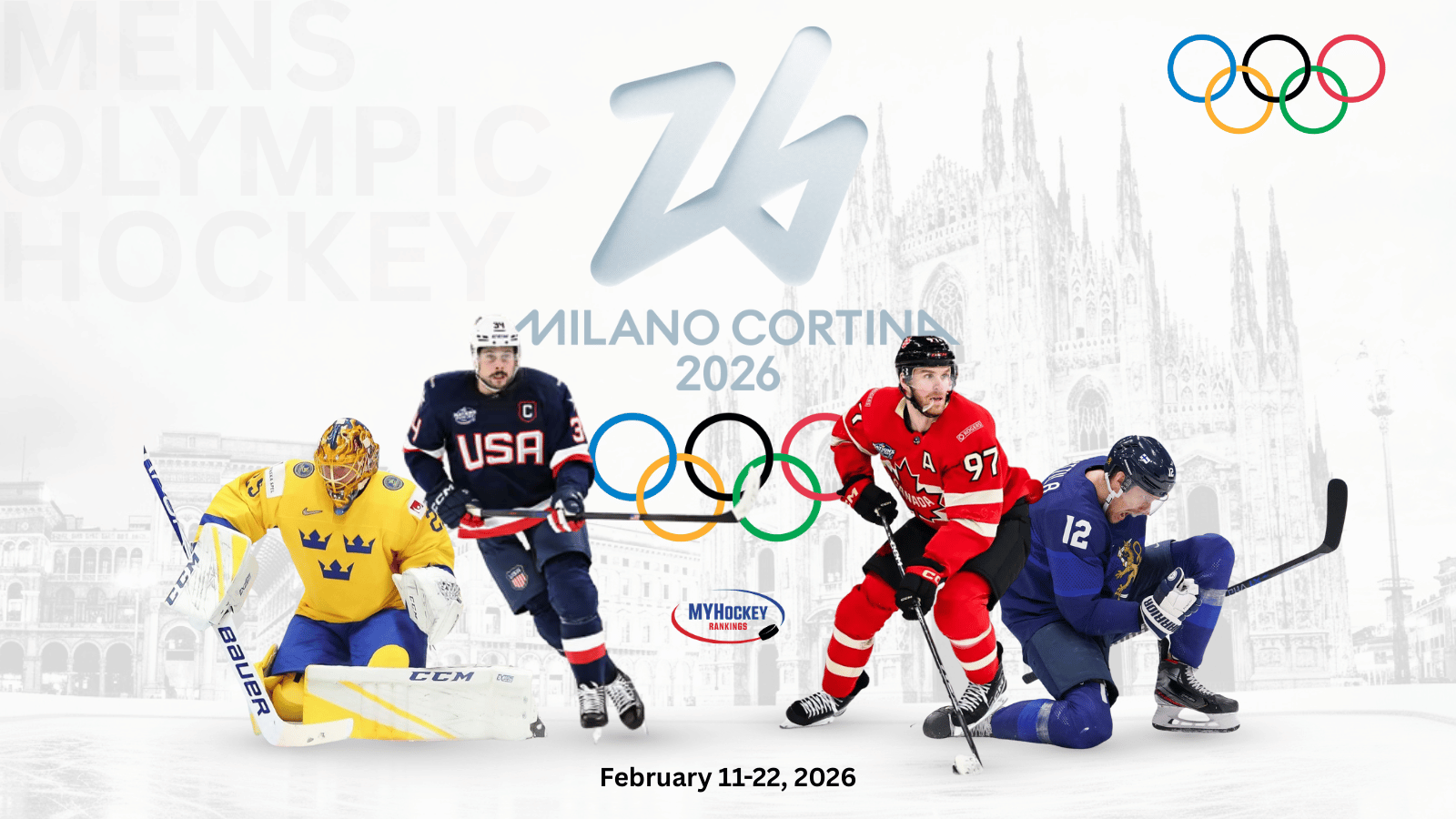
Men's Olympic Hockey Preview & Viewing Guide: NHL Teammates Become Foes in the Quest for Gold
By Scott Lowe – MYHockeyRankings.com
It’s a comment those of us who follow hockey either say or hear frequently.
“Man, I hate that guy, but I’d love to have him on my team.”
That phrase has been uttered by hockey fans, players, coaches and general managers probably for as long as the sport has been played.
Brad Marchand is a prime example.
A high-energy player who plays on the edge, sometimes crosses the line of what’s considered acceptable and is extremely difficult to play against, Marchand has spent most of his career agitating and instigating his way to becoming one of hockey’s most-despised villains. Until last year it would have been difficult to find any hockey fan outside of New England who had anything positive to say about him as a player.
It’s safe to say that Matthew Tkachuk, another of the National Hockey League’s villains, probably didn’t harbor many kind thoughts about Marchand for the first 8-1/2 years of his NHL career either. Players who find themselves in those roles for their teams rarely get along on the ice, but that all changed for those two on March 7, 2025.
That’s the day the longtime Boston Bruins fan favorite was traded to Tkachuk’s Florida Panthers as part of a trade-deadline deal. Tkachuk and his teammates knew that Marchand still had plenty in the tank to help them win a second consecutive Stanley Cup, and that’s all that mattered. Anything that had happened in the past was wiped from the slate. From that point forward they were brothers in arms, and three months later Florida was back on top of the hockey world with Marchand and Tkachuk leading the team celebration and carrying the Stanley Cup around South Beach.
While hockey players and coaches easily compartmentalize past hard feelings and readily welcome any player – even their fiercest and most-hated rivals – into a team’s locker room with open arms if the player will help them win hockey games, the men’s hockey tournament at the 2026 Milano Cortina Winter Olympics is sure to test the ability of many fans to do the same.
Marchand and Tkachuck once again make great case studies as they will be playing on different Olympic teams that happen to be international hockey’s fiercest rivals. With NHL players competing in the Winter Olympics for the first time since 2014, there is no guarantee that the United States and Canada even will meet in Italy, but if they do it will be in a playoff-round elimination game that will mean everything to the players on both teams.
Tkachuk and his brother Brady, who are likely to play on the same line for Team USA, were the ringleaders who ignited a series of three fights in a nine-second span the first time the two North American rivals met a year ago in the 4 Nations Face-Off. That was before Marchand had been traded to Florida. This year, the two world-class agitators will be representing their homelands and potentially playing against each other on the world’s biggest hockey stage in one of hockey’s all-time most-anticipated international tournaments.
As always, they will do whatever they can to help their teams win and be extremely effective in their efforts to get under the skin of their opponents. And yes, it’s almost certain that if the two nations face off those two will end up battling or hitting or chirping at or shoving or punching each other at some point. That’s just what they do; it’s how they are wired.
Of course, they also will shake hands and hug when it’s all over in a sign of mutual respect, because that’s also what hockey players do. A few weeks later they will be back together in Florida playing as teammates again with one common goal in mind.
This all seems easy and natural for high-level hockey players, but how will the fans handle it?
How are Penguins and Capitals fans who live in the Pittsburgh and Washington areas going to comprehend Sidney Crosby and Tom Wilson playing together on the same team for a country that is their biggest hockey rival?
Are Caps fans going to root against their hometown hero, a guy they have stood behind through thick and thin as he has developed from a fourth-line fighter with a bad reputation to a potential first-line forward on what could be the best hockey team in the world?
It seems like Wilson’s new teammates and coaches have done what hockey dudes do and embraced him as a guy who can make a difference by scoring an important goal, delivering a big hit or just being a unifying presence in the locker room.
“{He’s} full of life,” Team Canada Coach Jon Cooper told the media covering the Olympic hockey tournament. “He’s unbelievable this guy. He just lights up the room when he comes in. He’s extremely positive. He’s really driven ... What a teammate. Pretty fired up to have him. We all know what he can do on the ice, but he may even be better off the ice.”
What happened before the puck drops on the two nations’ first Olympic games Thursday, Feb. 12, and what happens once the NHL season resumes Feb. 25 have no bearing on this tournament for anyone associated with the North American teams. The goal is the same for everyone on both rosters: to return home with a gold medal.
“We picked this team for a reason,” Cooper said. “I mean, this is the elite of elite in Canada.
Team USA Coach Mike Sullivan told reporters that he really likes his team’s versatility up and down the lineup, and General Manager Bill Guerin echoed that. As Herb Brooks said when selecting the 1980 U.S. team that shocked the world and captured a gold medal, “I’m not looking for the best players. I’m looking for the right players.”
"The chemistry {of the 4 Nations team} allowed the guys to play the way that they did — the willingness to accept their role, the willingness to do things that they are not asked to do with their NHL team, to take less ice time and play a different role," Guerin said.
It may sound like a broken record, but again that's just what hockey players do. They sacrifice for the greater good of the team, and that almost never can be questioned at the sport’s highest levels. That mentality may be a little harder for fans to adopt heading into these Winter Olympics, however.
Are Lighting fans going to be able to cheer for Matthew Tkachuk, who plays for their most-hated NHL rival, and Team USA a week after he hit their best player way behind the play and then went toe-to-toe with Tama Bay forward Brandon Hagel, who by the way will be playing for Canada in the Olympics and was the player Tkachuk fought at the 4 Nations Face-Off?
The other Tkachuk, Brady, is no angel either and probably doesn’t have many friends or fans around the NHL outside of Ottawa. But he’s the Senators’ captain and will be playing for the bitter rival of his team’s fanbase at the Olympics.
How will Winnipeg Jets fans feel if Connor Hellebuyck, their goalie and unquestionably one of the top five netminders in the world, leads Team USA to a gold medal after his well-documented playoff struggles for their favorite NHL team?
Winnipeg forward Kyle Connor joins Hellebuyck on the Team USA Roster, while Ottawa defenseman Jake Sanderson will be playing alongside teammate Brady Tkachuk for the Americans. Toronto Maple Leafs star Auston Matthews is expected to be a key player for the United States. Meanwhile, 22 of the 25 players on the Team Canada roster play for USA-based NHL teams.
With hockey being one of Canada’s national sports, rallying behind the national team for any international tournament never has been an issue for fans north of the border. The vast majority of Canada’s roster playing for NHL teams in the U.S. means that experiencing conflicting emotions is less likely for Canadian fans, which probably makes it even easier – among other reasons – for them to root against the Americans at any cost.
Only diehard hockey fans in the United States feel the same passion for the USA-Canada rivalry that most Canadians do, and it seems likely that many Americans would even pull for Canada if players from their favorite NHL teams are on the roster when the Canadians aren’t playing against the United States. In fact, U.S. hockey fans probably would prefer to see the two nations play at some point during the knockout stage of the tournament for the sheer entertainment value, while for Canadian fans the gold medal is all that matters and they would be happy to see Team USA eliminated by anyone at any time.
Of course, there also will be many people in the U.S. who only watch hockey during the Olympics and only will care about how the Americans perform. Although these are two of the top hockey-playing nations in the world who are neighbors within the same continent, the fanbases and passion for the sport are different. In addition, the political climate in the United States seems likely to fan the flames of Canada’s hatred for Team USA, while it remains to be seen how it might impact the fan support among citizens of an America that is extremely divided.
No matter who fans are supporting, though, everyone wins when there is an international hockey tournament that features most of the world’s top players.
And that’s what we have here, starting Feb. 11.
Men’s Olympic Hockey Tournament Format
Unfortunately. because of the tournament format, there is no guarantee that the United States and Canada will play each other during the Milano Cortina Olympics.
The tournament field consists of 12 teams divided into three groups of four. Teams in each of the four groups play each other once starting on Wednesday, Feb. 11, with the top finisher in each group and the best second-place team overall advancing to the quarterfinals. The remaining teams play in a qualifying round to see who will fill the remaining three quarterfinal spots.
Canada, Finland, the USA, Germany, Sweden, Switzerland and Czechia were seeded based on their 2023 International Ice Hockey Federation (IIHF) world ranking. Italy is the host country and received an automatic berth into the tournament, while Slovakia, Latvia, Denmark and France earned spots through a qualifying tournament.
The Olympic Men’s Hockey group assignments are as follows:
Group A
Canada, Czechia, Switzerland, France
Group B
Slovakia, Finland, Sweden, Italy
Group C
USA, Latvia, Germany, Denmark
Group A Preview
Canada, of course, is the favorite to earn the top seed in Group A, but it won’t be an easy path.
Goaltending has been the main question surrounding the Canadian team, but Darcy Kuemper has won a Stanley Cup and was a Vezina Trophy finalist a year ago, Logan Thompson has been one of the NHL’s top five goalies for the past two seasons and Jordan Binnington was outstanding at the 4 Nations tournament. In addition to the players previously mentioned, Canada has the deepest lineup of highly skilled players, including Connor McDavid, Nathan MacKinnon, Mitch Marner, Sam Reinhart and Macklin Celebrini. The defense is as strong and deep as any team in the tournament, led by Cale Makar, Shea Theodore, Devin Toews and veteran Drew Doughty.
Czechia has emerged on the world stage as a medal contender at all levels in recent years and has familiar NHL names such as Tomas Hertl, Martin Necas, Ondrej Palat, David Pastrnak, Radko Gudas, Filip Hronek, Dan Vladar and Lukas Dostal on its roster.
Switzerland has some strong top-end talent in Nico Hischier, Timo Meier, Nino Niederreiter, Roman Josi and Kevin Fiala but lacks depth and a shutdown goaltending presence.
Group B Preview
Every international sports tournament has a Group of Death, and that’s what Group B is for this Olympics.
Sweden and Finland are bitter rivals that regularly compete for medals at all levels of international hockey and have won gold medals on the world stage. A tier below them, Slovakia still has enough firepower to be competitive and win games it shouldn’t.
Finland and Sweden met once at the 4-Nations Face-Off, with the hobbled Finns earning a 4-3 overtime victory on a goal by Markus Granlund.
Finland is known for playing an edgy and disciplined defensive style and has enough talent to compete at a high level in short tournaments. The Finns will miss injured Aleksander Barkov, it’s captain a year ago and another Stanley Cup winner with the Panthers, but there still are NHL-caliber players throughout the lineup, including Granlund, Joel Armia, Sebastian Aho, Erik Haula, Roope Hintz, Kaapo Kaako, Anton Lundell, Mikko Rantanen, Teuvo Teravainen, Miro Heiskanen, Esa Lindell and Rasmus Ristolainen.
Likewise, Sweden is not lacking in high-end talent led by Mika Zibanejad, William Nylander, Filip Forsberg, Elias Pettersson, Gabriel Landeskog, Elias Lindholm, Victor Hedman, Rasmus Dahlin, Erik Karlsson and Oliver Ekman-Larsson. The smooth-skating Swedes play with a higher skill level and degree of difficulty than the Finns but also are extremely responsible defensively.
Slovakia’s familiar NHL faces include Dalibor Dvorsky, Martin Pospisil, Pavol Regenda and Juraj Slafkovsky up front along with Erik Cernak, Martin Fehervary and Simon Nemec on the blue line. The team simply isn’t as deep and doesn’t have the proven goaltending that Sweden and Finland have.
Group C Preview
While the United States may not have the as many highly skilled players up front as Canada, the lineup has plenty of offensive firepower and elite goaltending in Hellebuyck and Jake Oettinger. If those guys are off their games for some reason, Jeremy Swayman is a pretty good third option in net.
The Americans have surrounded high-end forwards such as Jack Eichel, Connor, Jake Guentzel, Jack Hughes, the Tkachuks and Matthews with strong two-way players who will be playing in familiar roles to balance the attack. Quinn Hughes, a banged-up Charlie McAvoy, Brock Faber and Jacob Slavin anchor a deep defensive unit.
The U.S. does not figure to face a terribly difficult road to the quarterfinals, but Germany is an emerging hockey nation that is producing more NHL-level talent than ever and won an Olympic silver medal in 2018.
Germany fell to 10th in 2022, however, and while the Germans have a few high-end players who can compete with anyone, depth is likely going to be what holds them back. High-scoring Edmonton Oilers sniper Leon Draisaitl leads a forward group that includes Utah’s J.J. Peterka, Vancouver’s Lukas Reichel, Minnesota’s Nico Sturm and Ottawa’s dynamic Tim Stutzle. Detroit Red Wing Moritz Seider anchors the defense, and goalie Philipp Grubauer is having a strong year for Seattle.
Zemgus Girgensons, Teddy Blueger, Rodrigo Abols and Uvis Balinskis highlight Latvia’s roster along with goalies Artus Silovs and Elvis Merzlikins. Denmark’s NHL contingent includes Oliver Bjorkstrand, Nikolaj Ehlers, Lars Eller and Oscar Fisker Molgaard up front along with goalies Frederik Andersen and Mads Sogaard.
Men’s Olympic Hockey Schedule
Play begins Feb. 11 at 10:40 a.m. EST when Slovakia faces Finland at 10:40 a.m. in a Group B matchup. Sweden and Italy face off later that day at 3:10 p.m. Groups A and C get underway Thursday, Feb. 12, with Canada opening play against Czechia at 10:40 a.m. EST and the United States taking on Latvia at 3:10 p.m.
Pool play continues through Feb. 15, with playoff qualification round scheduled for Feb. 17 and quarterfinals slated for Feb. 18. The semifinals will be played Feb. 20, followed by the Bronze Medal Game Feb. 21 and the Gold Medal Game Feb. 22.
Games are being played at Milano Santagiulia Ice Hockey Arena and Milano Rho Ice Hockey Arena.
Teams are awarded three points for a regulation win, two points for an overtime or shootout win, one point for an overtime or shootout loss and zero points for a regulation loss. If there is a tie in the standings after round-robin play, goal differential is the first tie-breaker, followed by total goals scored and finally the better 2020 IIHF world ranking.
Games that are tied at the end of regulation time during pool play will go to a five-minute, 3-on-3 sudden-victory playoff followed by a shootout if neither team scores. If overtime is required in the playoff qualification round, a quarterfinal game, a semifinal game or the Bronze Medal Game, there will be a 10-minute, 3-on-3 sudden-victory overtime followed by a shootout if no winner has been determined. For the Gold Medal Game, 20-minute, 3-on-3 overtimes will be played until there is a winner.
CLICK HERE for the complete Olympic men’s hockey schedule
Men’s Olympic Hockey Viewing Information
Olympic hockey games can be seen in Canada via national broadcasts on CBC, TSN and Sportsnet. Games also will be available on the CBC Gem streaming service.
Games will air on NBC, CNBC and USA Network in the United States, with NBC serving as the national broadcast rights holder. Streamed games can be viewed on Peacock and NBC Sports platforms.
USA Network will broadcast the American men’s preliminary-round games, teaming up with CNBC to broadcast many other opening-round contests. Peacock will be the streaming service for the Milano Cortina Games in the U.S., with every game available live there.
To accommodate the time difference between Italy and North America, there will be live broadcasts of nearly every game and tape-delayed broadcasts of select games. Live and tape-delayed broadcasts of all medal-round games will be available, and any games that American viewers miss can be seen on-demand via Peacock.
CLICK HERE for the CBC complete Olympic hockey streaming schedule (Canada).
Complete Men's Olympic Ice Hockey TV Schedule (USA Broadcast)
|
Game |
Date |
Time |
Channel |
|
Slovakia vs. Finland |
Feb. 11 |
10:40 a.m. ET |
USA Network |
|
Sweden vs. Italy |
Feb. 11 |
3:25 p.m. ET |
USA Network |
|
Czechia vs. Canada |
Feb. 12 |
10:30 a.m. ET |
USA Network |
|
Latvia vs. USA |
Feb. 12 |
3:00 p.m. ET |
USA Network |
|
Germany vs. Denmark |
Feb. 12 |
8:00 p.m. ET |
USA Network |
|
Finland vs. Sweden |
Feb. 13 |
7:30 a.m. ET |
USA Network |
|
Canada vs. Switzerland |
Feb. 14 |
12:30 a.m. ET |
USA Network |
|
Germany vs. Latvia |
Feb. 14 |
6:00 a.m. ET |
USA Network |
|
Finland vs. Italy |
Feb. 14 |
10:40 a.m. ET |
USA Network |
|
USA vs. Denmark |
Feb. 14 |
3:10 p.m. ET |
USA Network |
|
Sweden vs. Slovakia |
Feb. 14 |
8:00 p.m. ET |
USA Network |
|
Switzerland vs. Czechia |
Feb. 15 |
6:00 a.m. ET |
CNBC |
|
Canada vs. France |
Feb. 15 |
10:40 a.m. ET |
USA Network |
|
Denmark vs. Latvia |
Feb. 15 |
1:00 p.m. ET |
USA Network |
|
USA vs. Germany |
Feb. 15 |
3:10 p.m. ET |
USA Network |
|
Men's Qualification Playoff |
Feb. 17 |
12:15 p.m. ET |
USA Network |
|
Men's Qualification Playoff |
Feb. 17 |
3:10 p.m. ET |
USA Network |
|
Men's Qualification Playoff |
Feb. 17 |
8:00 p.m. ET |
USA Network |
|
Men's Quarterfinal |
Feb. 18 |
10:40 a.m. ET |
USA Network |
|
Men's Quarterfinal |
Feb. 18 |
1:00 p.m. ET |
USA Network |
|
Men's Quarterfinal |
Feb. 18 |
3:10 p.m. ET |
Peacock |
|
Men's Quarterfinal |
Feb. 18 |
6:00 p.m. ET |
USA Network |
|
Men's Semifinal |
Feb. 20 |
11:50 a.m. ET |
USA Network |
|
Men's Semifinal |
Feb. 20 |
3:10 p.m. ET |
Peacock |
|
Men's Bronze Final |
Feb. 21 |
2:40 p.m. ET |
USA Network |
|
Men's Gold Final |
Feb. 22 |
8:10 a.m. ET |
NBC |