
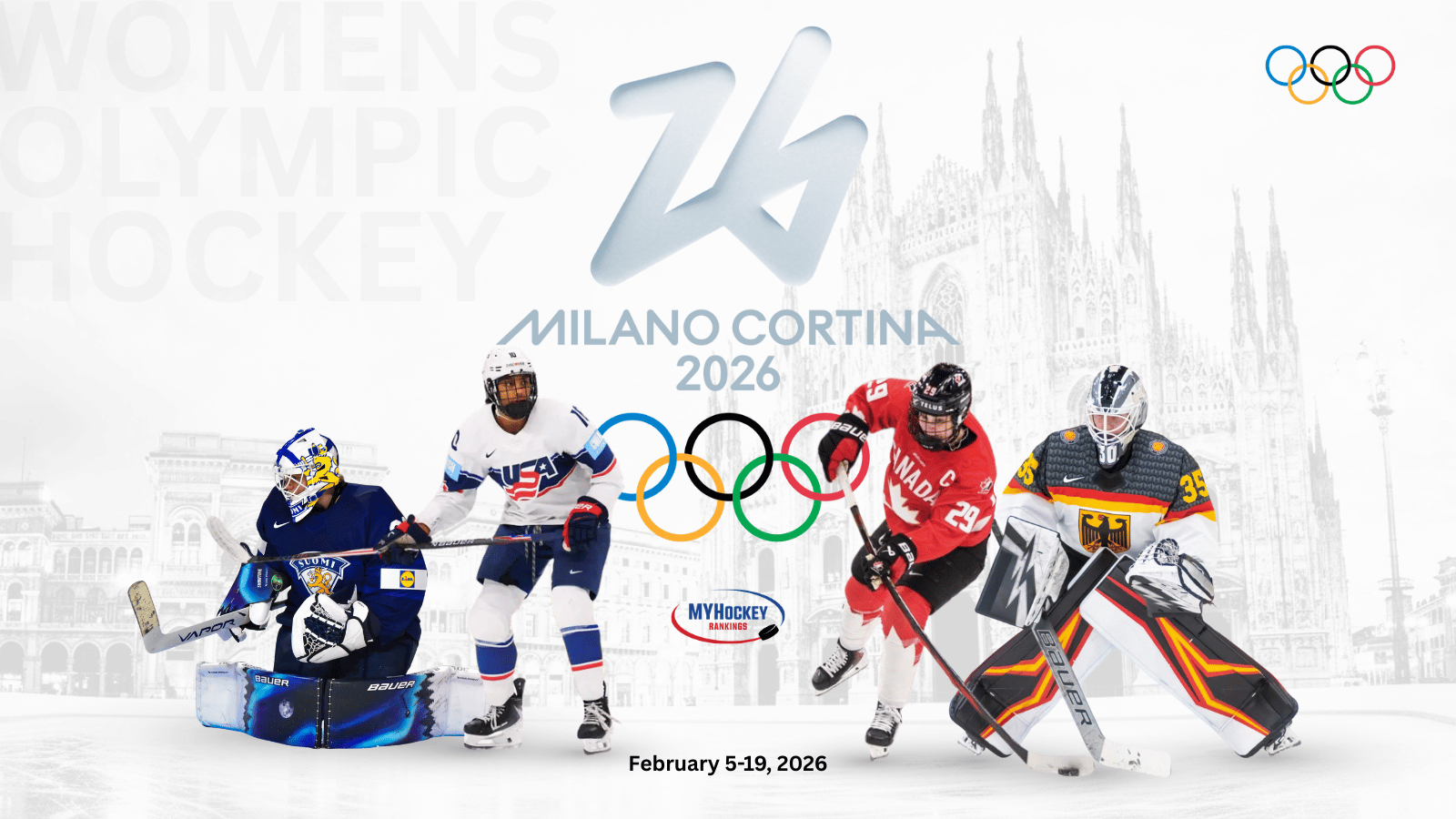
Women's Olympic Hockey Preveiw & Viewing Guide: Groundhog Day in Italy?
By Scott Lowe - MYHockeyRankings.com
After four years of some uncertainty, quite a bit of build-up and even a little rink-construction drama, the event that hockey enthusiasts around the globe have been anticipating finally is staring us in the face.
At this point, there’s no turning back.
North American hockey fans are well aware that the 2026 Winter Olympics are here and almost every one of the world’s best men’s and women’s players will be competing. But there always seems to be a little bit of mystery when it comes to hockey at the Olympics in terms of the tournament format, the rules, the television coverage and the time difference.
Hockey is a contact sport, so unfortunately because of injuries some of the world’s top players will miss out on the opportunity to compete at the 2026 Milano Cortina Winter Games in Italy. The ban preventing Russia from competing in international tournaments also means that the top Russian players won’t be there. But other than that, this is a rare opportunity for hockey fans to watch the best of the best competing and representing their home nations on the largest international sports stage.
Last year’s popular and intense 4 Nation’s Face-Off, which featured National Hockey League players from the world’s top hockey-playing nations competing in a tournament format, only served as an appetizer for this year’s main course. While that tournament initially was met with skepticism because it was new and no one knew quite what type of effort to expect from NHL players competing in the middle of their professional seasons, it immediately became obvious that any event featuring the world’s best representing their native countries was going to take on the intensity of the Stanley Cup Playoffs.
That tournament only featured the United States, Canada, Sweden and Finland, so the expectations for the 2026 men’s Olympic competition are off the charts with the addition of eight more hockey-playing nations to the field. This year marks the first time since 2014 that NHL players will be participating.
On the women’s side, just about every year we are treated to a United States vs. Canada grudge match for a gold medal at the Women’s World Championship. And while those WWC matchups almost always turn out to be one-goal thrillers that often require overtime to determine a winner, they are viewed mainly by hardcore North American hockey fans, and nothing compares to the intensity of the games when the two North American hockey superpowers face off at the Olympics.
Past Olympic matchups between Team USA and Canada have been among the most watched and talked about events of any given year’s Winter Games. Fortunately, because of the format of the Olympic women’s tournament we are guaranteed at least one meeting between the two bitter rivals this year. The hope among North American fans, however, is that there will be two memorable USA vs. Canada matchups, with the second deciding who comes home with the gold medal.
It’s a pretty safe bet that will happen considering that the two nations have met in the gold-medal game six of the seven times women’s hockey has been included in the Winter Olympics, dating to the 1998 Nagano Games.
Interest in women’s hockey has skyrocketed in recent years thanks to increased television coverage of international tournaments paired with the creation and success of the Professional Women’s Hockey League in North America. The popularity and viability of a true women’s pro league has afforded the world’s best players an opportunity to play against and train with other top players for eight months out of the year. By default, that raises the level of play across the sport, and the annual influx of new European stars every year pushes the overall level even higher both in North America and abroad.
While women’s hockey has created a substantial buzz during previous Winter Olympics, the sport never has been able to fully capitalize on that interest and momentum because there really was no way for the sport’s newly created fans to follow the players once the Games concluded. Some players returned to Europe to finish their professional seasons there, others went back to North America and returned to their college teams, a handful might have played in one of the poorly funded and promoted North American pro leagues and others simply returned home and waited patiently for their next opportunity to play in an international tournament.
That all has changed with the emergence of the PWHL.
In just its third year of existence, the league has obliterated all reasonable expectations in terms of in-person attendance and worldwide broadcast and internet viewers. The PWHL will reach more than 96-million homes with 7,200 minutes of action from its 120 games during the 2025-26 season. There will be 60 PWHL players competing for various nations at the Milano Cortina Olympics, so anyone tuning in to watch women’s hockey for the first time ever or the first time since the last Olympics will be able to continue watching many of the stars they see when they return to the PWHL to finish this season and in the subsequent years leading up to the next Olympics.
Between the success of the 4 Nation’s Face-off and the rise of the PWHL, hopes are high that the 2026 Milano Cortina Olympic hockey tournaments will produce some of the best hockey ever played.
The women’s Olympic tournament begins bright and early the morning of Thursday, Feb. 5, with Sweden taking on Germany at 6:10 a.m. EST. That is followed at 8:40 a.m. by a matchup between Italy and France. The United States opens play at 10:40 a.m. vs. Czechia, with Canada playing its opener against Finland at 3:10 p.m.
Women’s preliminary-round play concludes Feb. 10. The United States takes on Canada that day at 2 p.m. in what figures to be a battle for the top seed in Group A. Quarterfinals are scheduled Feb. 13 and 14, with the semifinals slated for Feb. 16 and the medal round set for Feb. 19.
The men’s tournament gets underway Feb. 11, with Canada and the United States opening play the following day. Canada has a challenging opening game against Czechia Feb. 12 at 10:40 a.m. EST, while the U.S. faces Latvia at 3:10 p.m. The tournament format precludes Canada and the United States from playing each other until the playoff round.
CLICK HERE for the complete Olympic women’s hockey schedule.
CLICK HERE for the complete Olympic men’s hockey schedule
Women’s Olympic Hockey Tournament Format
The women’s tournament is divided into two five-team groups:
- Group A:Canada, Czechia, Finland, Switzerland, USA
- Group B:France, Germany, Italy, Japan, Sweden
Group A features the world’s top-ranked nations based on their finish in the most recent International Ice Hockey Federation Women’s World Championship. Group B is comprised of the host nation and four teams that earned their way into the field via qualification tournaments.
All five Group A teams automatically advance to the quarterfinals along with the top three teams from Group B. Group A teams face each other once during the preliminary round, while Group B teams also play each other once to determine playoff seedings.
Group A’s first-place team takes on the third-place team from Group B in the quarterfinals. In other quarterfinal matchups, the second-place Group A finisher faces the second-place Group B team, the third-place Group A team takes on the top finisher from Group B and the bottom two Group A teams play each other.
Standings are determined using a three-point system, with teams earning three points for a victory in regulation time, two for an overtime or shootout victory, one for an overtime or shootout loss and none for a regulation loss.
Preliminary-round games that are tied after 60 minutes will head to a five-minute, three-on-three, sudden-victory overtime period. If the game remains tied after overtime, there will be a shootout. In the quarterfinals there will be one 10-minute, three-on-three, sudden-victory overtime followed by a shootout if the game remains tied. There will be no shootouts for the medal-round games. Overtime for those contests will be 20-minute, 3-on-3, sudden-victory periods played in succession until there is a winner.
Games are being played at the infamous Milano Santagiulia Ice Hockey Arena, which may very well be under construction right up until the opening puck drop, and Milano Rho Ice Hockey Arena. Milano Santagiulia Arena holds 14,000 spectators, and the capacity for Milano Rho Arena is 5,700.
Groundhog Day All Over Again?
The United States and Canada have met for the gold medal at seven of the eight Winter Olympics that have featured women’s hockey, dating to the Nagano Games in 1998. Canada has captured five gold medals, with the Americans earning two golds and one bronze. The U.S. has won two of the last three world championships, however, and more recently swept the Canadians in the four-game pre-Olympic Rivalry Series by a combined margin of 24-7.
Dating to last spring’s Women’s World Championship, the U.S. has won the last six meetings between hockey’s dominant nations, causing some analysts to label Team Canada as the underdog heading into the Olympics. Based on pre-tournament comments, it seems as though the Canadian players may be embracing that role and using it for motivation.
“I think we’re the underdogs … in some people’s eyes,” Team Canada assistant captain Blayre Turnbull told CBC. “I think if you look at our recent games against them, yeah, we got smoked, but I think if you look at our games against them throughout the last [four years], I don’t think that our recent games tell the whole story."
Realistically there is no underdog when these two nations collide in women’s hockey. When something important – like a gold medal – is on the line, the most likely outcome is a one-goal thriller that is decided late or requires overtime.
Both U.S. victories at last year’s Women’s World Championship were by a single goal, including a 4-3 overtime win in the gold-medal game. The teams split their two meetings in Utica, N.Y., at the 2024 World Championship, with Canada winning the gold in overtime, 6-5, after the U.S. had skated to a 1-0 overtime preliminary-round win. The Americans captured the 2023 WWC gold with a 6-3 victory, but the preliminary-round matchup went to Canada that year by a 4-3 margin. And the last time the two nations faced off in the Olympics at the 2022 Beijing games, the Canadians captured the gold medal with a 3-2 victory.
There’s no reason to expect anything different in Milan even If the United States is considered the favorite and enters the Olympics ranked No. 1 in the world.
“It’s a clean slate every time you get to a tournament,” USA captain Hilary Knight told reporters in Italy this week. “You have to work hard.”
Knight, one of the sport’s icons and the all-time leading scorer in women’s international play, is competing in her fifth and final Olympics. She is looking to return home with her fifth medal and is one of the veteran leaders on a team with a nice mix of youth and experience. Knight is the only five-time Olympian in U.S. women’s hockey history and hopes the medal she earns this time is her second gold.
Eleven players return from the USA’s 2022 silver-medal team, with four players ranking among the PWHL’s top six scoring forwards. Speedy veteran forward Kendall Coyne Schofield is tied for the league lead in points with Team USA teammates Taylor Heise and Britta Curl-Salemme. Megan Keller is participating in her third Olympics and leads all PWHL defenders in scoring, while second-time Olympians Abbey Murphy and Caroline Harvey rank first and second in NCAA scoring.
Canada brings its usual veteran squad to Italy, with 16 players returning from the team that won gold in Beijing. Ten of those players were on the team that lost the gold-medal game in a shootout to the U.S. in 2018.
Like Knight, Canada’s “Captain Clutch” Marie-Philip Poulin is playing in her fifth Olympics. She has made a habit of shattering Team USA’s gold-medal dreams and has scored in each of the four Olympic gold-medal games she has played in, netting the “golden goal” three times. Three other Canadian players, including Beijing Olympic MVP Brianne Jenner, are appearing in their fourth Olympics.
Defender Renata Fast has developed into one of the world’s top defenders, and forward Sarah Nurse returns after setting the Olympic single-tournament assist and points records in 2022.
The vets are joined by 2025 PWHL Rookie of the Year Sara Fillier and Daryl Watts, who ranks third in the league in scoring. Fillier had 11 points in her 2022 Olympic debut, and goaltender Ann-Renee Desbiens never has lost at the Olympics in six starts. She posted a .940 save percentage in Beijing and is the PWHL’s all-time leader in save percentage, goals-against average and wins. Desbiens hasn’t allowed more than two goals in any PWHL appearance this season.
“Gold is always the goal,” Team USA’s Keller said. “We want to represent our country proudly and we have one color in mind, one medal in mind, that we want to win. Hopefully we can achieve that. That's everybody's dream, and everybody's goal is to bring back gold for our country.”
While the Canadian and American players dream about gold medals, players representing other countries hope for a miracle upset win against one of the North American powers and to return home with a medal of any kind. Sweden is the only team other than the U.S. or Canada to play for a gold medal, but in recent years Finland and Czechia have proven on the world stage that on a given day they can be capable of pulling off a major upset.
The U.S. and Canada are the clear favorites to play for the gold medal, but it’s not a slam dunk, and either team could be vulnerable against the Finns or Czechs if they aren’t on top of their game. It does appear likely that Finland and Czechia will play for the bronze medal, although Sweden is always lurking and capable of earning a spot in the medal round.
CLICK HERE for the Team USA roster.
CLICK HERE for the Team Canada roster.
Women’s Olympic Hockey Viewing Information
Canada, women’s Olympic hockey games can be seen via national broadcasts on CBC, TSN and Sportsnet. Games also will be available on the CBC Gem streaming service.
Games will air on NBC, CNBC and USA Network in the United States, with NBC serving as the national broadcast rights holder. Streamed games can be viewed on Peacock and NBC Sports platforms.
USA Network will broadcast the American men’s and women’s preliminary-round games, teaming up with CNBC to broadcast many other opening-round contests. Peacock will be the streaming home for the Milan Cortina Games in the U.S., with every game available live there.
To accommodate the time difference between Italy and North America, there will be live broadcasts of nearly every game and tape-delayed broadcasts of select games, Live and tape-delayed broadcasts of all medal-round games will be available, and any games that American viewers miss can be seen on-demand via Peacock.
CLICK HERE for the CBC women’s hockey streaming schedule (Canada).
Women's Olympic Ice Hockey TV Broadcast Schedule (USA)
|
Game |
Date |
Time |
Channel |
|
USA vs. Czechia |
Feb. 5 |
10:40 a.m. ET |
USA Network |
|
Finland vs. Canada |
Feb. 5 |
3:45 p.m. ET |
USA Network |
|
USA vs. Finland |
Feb. 7 |
10:40 a.m. ET |
USA Network |
|
Switzerland vs. Canada |
Feb. 7 |
3:10 p.m. ET |
USA Network |
|
Sweden vs. Italy |
Feb. 7 |
9:00 p.m. ET |
USA Network |
|
Czechia vs. Finland |
Feb. 8 |
5:00 p.m. ET |
USA Network |
|
France vs. Sweden |
Feb. 8 |
8:30 p.m. ET |
USA Network |
|
Germany vs. France |
Feb. 9 |
12:00 p.m. ET |
USA Network |
|
Switzerland vs. USA |
Feb. 9 |
2:40 p.m. ET |
USA Network |
|
Canada vs. Czechia |
Feb. 9 |
5:00 p.m. ET |
USA Network |
|
Canada vs. USA |
Feb. 10 |
2:10 p.m. ET |
USA Network |
|
Women's Quarterfinal |
Feb. 13 |
3:10 p.m. ET |
USA Network |
|
Women's Quarterfinal |
Feb. 13 |
8:00 p.m. ET |
USA Network |
|
Women's Quarterfinal |
Feb. 14 |
10:40 a.m. ET |
CNBC |
|
Women's Quarterfinal |
Feb. 14 |
3:10 p.m. ET |
CNBC |
|
Women's Semifinal |
Feb. 16 |
10:40 a.m. ET |
NBC |
|
Women's Semifinal |
Feb. 16 |
4:15 p.m. ET |
USA Network |
|
Women's Bronze Final |
Feb. 19 |
12:00 p.m. ET |
USA Network |
|
Women's Gold Final |
Feb. 19 |
1:10 p.m. ET |
USA Network |